When More Isn't Better
Rethinking Training in Elite Sport

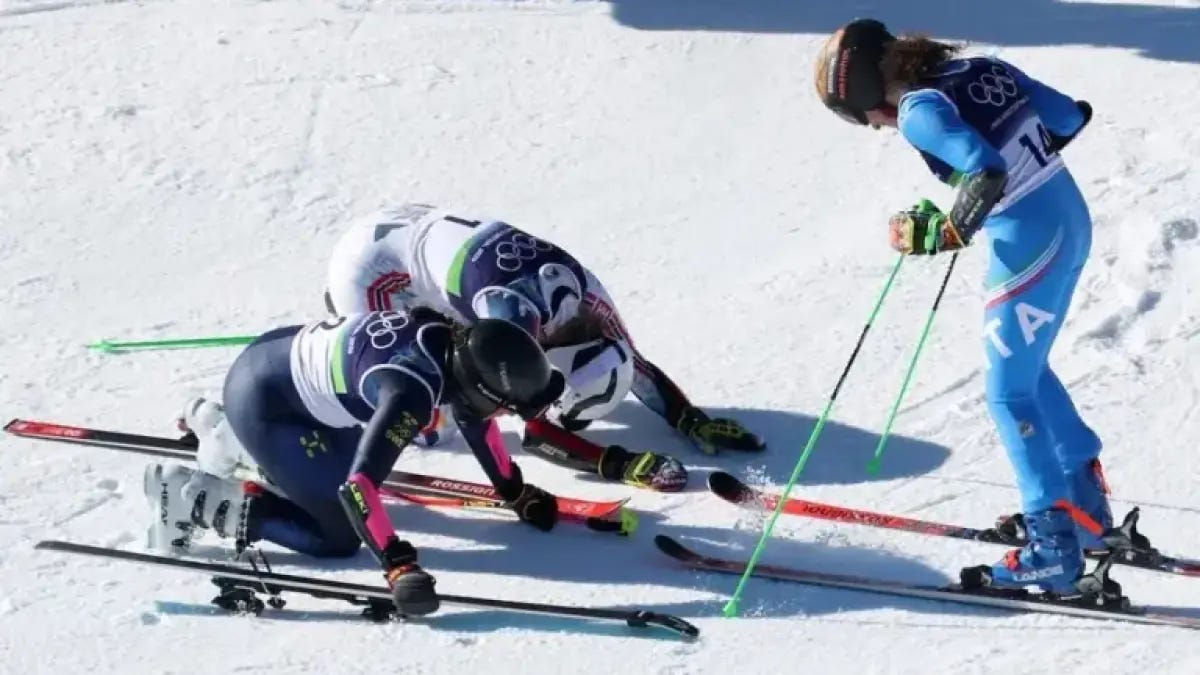
Thirty-five-year-old Federica Brignone has just won two gold medals at the 2026 Winter Olympics, her fifth Games - with silver and bronze medals to her name.
But what makes this story remarkable isn’t the medals.
In April 2025, Brignone suffered a significant crash resulting in multiple fractures in her leg and an ACL rupture. She underwent multiple surgeries and faced extensive rehabilitation. At one point, she didn’t know if she would walk properly again, let alone ski.
She returned to competition just one month before the Olympics. Two competition runs.
That was it.
Unable to train fully due to ongoing pain, she focused on pain management, recovery and completing her events, the Super-G and Giant Slalom. Her mindset shifted.
“My attitude was just to be happy to be here,” she said.
“That was already an achievement. Just to be back as an athlete… I was not feeling pressure… I was able to think about my skiing and let it go.”
No high-volume build-up.
No perfect preparation.
No excessive loading.
And yet, two gold medals.
Brignone even said that if she had come to the Olympics focused on winning medals, she doesn’t believe she would have won.
We saw a similar story in Paris with Australian swimmer Cameron McEvoy.
Working with coach Tim Lane, McEvoy reimagined his training. Instead of trying to make himself suit traditional swimming culture, high kilometres/ endless laps he made the sport suit him.
He reduced his weekly swim volume from around 30 kilometres to just two. He replaced pool kilometres with gym-based power training, drawing from dry-land sprint sports such as athletics and track cycling.
At 30 years old, after years of falling short of Olympic finals in the 50m freestyle, he won gold.
Less swimming.
More alignment.
Better performance.
I think about this often in relation to my own training.
During my peak CrossFit era in 2014–2015, I sometimes trained up to nine times per week while working full-time as a massage therapist. I chased double days: CrossFit, skills sessions, Olympic weightlifting. Saturdays were 90 minutes of weightlifting followed by a one-hour CrossFit class.
More felt virtuous.
More felt disciplined.
More felt like commitment.
More felt like increased chance of improvement.
Fast forward to 2026. I train four gym sessions per week, one run, and maybe a walk or ride. If my gym session goes longer than 75 minutes, I’m not impressed, I’m inefficient.
During COVID, when I had unlimited time and access to my home gym, while rehabbing a lumbar disk injury. Banded leg extensions and curls dragged on. The sessions became overextended. I remember feeling irritated not accomplished.
Unlimited time didn’t enhance my training.
It diluted it.
So, what does this tell us?
In elite sport, we often equate volume with dedication. We celebrate “grind culture.” We praise the athlete who does more.
I’ve witnessed coaches trying to figure out how to get more training in.
But Brignone’s and McEvoy’s story challenge that narrative (more = better).
Performance is not simply a function of volume. It’s a function of:
Precision
Adaptation
Psychological freedom
Energy management
And sometimes, constraint
When training time was limited, both athletes focused on what mattered most.
When pressure was removed, execution improved.
When identity wasn’t tied to workload, performance flourished.
With the number of athletes that sustained injuries during preparation for the Winter Olympics, it raised important questions:
Are we overloading in the name of optimisation?
Do we mistake exhaustion for effectiveness?
Is “more” sometimes just noise?
As we move into the next Olympic cycle, perhaps the question isn’t how to train more.
Perhaps it’s how to train better.
And maybe, just maybe, performance isn’t built in excess.
It’s built in alignment.